


Does This Voxel Sandbox Launch You to Glory or Leave You Stranded in the Cold?
Launching into the Void of Space Factory Simulation
Exploring a procedurally generated cosmos where every single asteroid and planetoid can be mined, melted down, and reassembled requires a keen eye for logistics and a massive appetite for automation. Our hands-on analysis focuses on how these intricate mechanics hold up when pushed to their absolute limits in both solo and co-operative play. Will this stellar adventure deliver a beautifully synthesised sandbox of endless potential, or will the gears jam before you even reach your first planetoid? Read on to find out!
Sifting the Cosmos for Voxel Riches
The journey begins on a deceptively simple premise. Rather than being guided by a heavy-handed narrative or dramatic storyline, you are driven by the pure instinct to survive, expand, and colonise. You start floating in the void on a tiny platform with a basic jetpack, manually mining passing asteroids for foundational minerals like iron, copper, and coal. The gameplay loop quickly transforms from basic survival into a massive logistics challenge as you construct automated asteroid catchers to drag floating debris from space directly into your production lines.

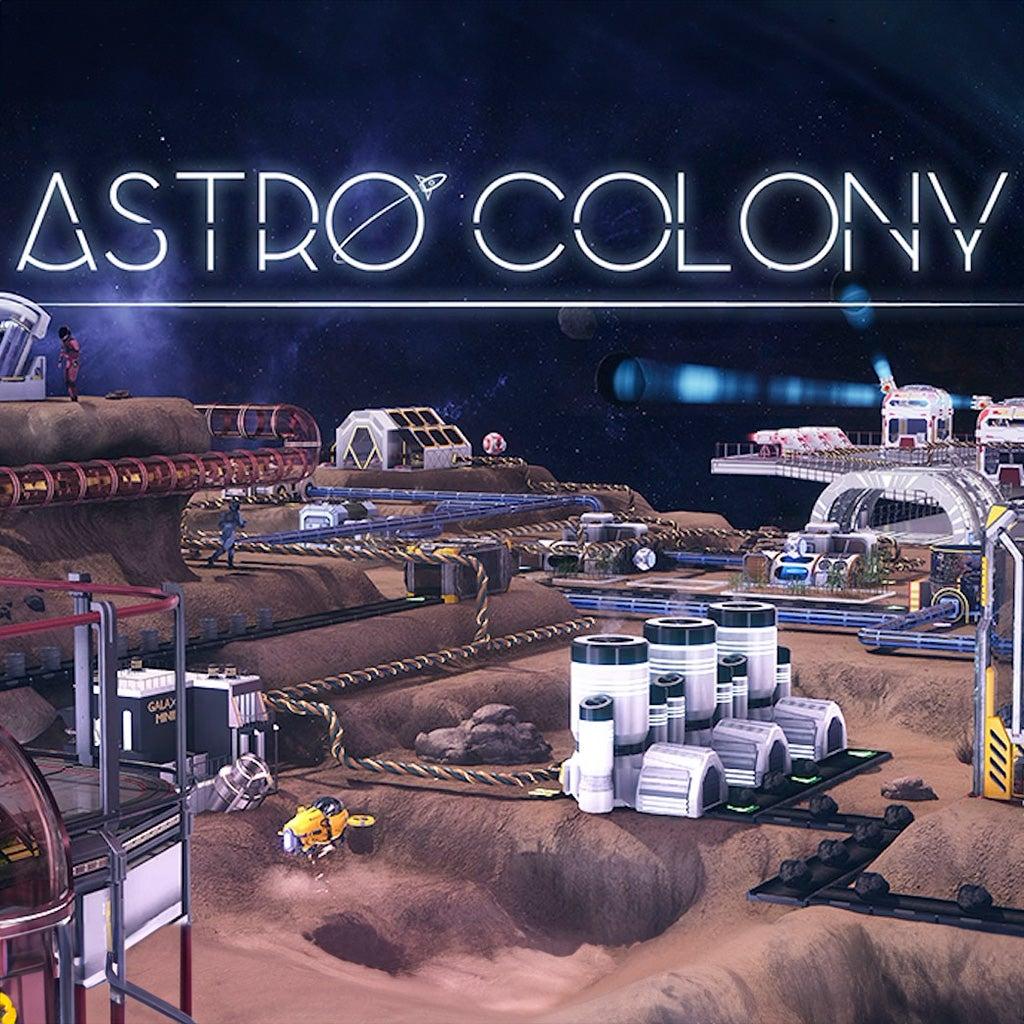
As shown in the image, a mature colony is a massive, multi-tiered construct of modular decks and floating structures. Notice how the conveyor belts transport raw materials from landing docks directly to refineries, whilst solar panels on the roofs provide the energy necessary to keep the entire network online. Once you attach thrusters to your main station, you can physically pilot your entire base through the cosmos to locate, explore, and dock with massive voxel planets. These planets are fully destructible, allowing you to deploy heavy automated drills to extract rarer minerals like aluminium and titanium, keeping your intergalactic empire running.
Interlocking Conveyors and Biological Needs
The core strength of Astro Colony lies in its deep, interlocking mechanics. Conveyor belts transport solid materials between storage containers, smelters, and assemblers, whilst a separate network of pipes manages the flow of liquids and gases like water, oxygen, and hydrogen. Power generation starts with basic coal burners but eventually expands to solar panels, which can be cleverly stacked indoors to save precious deck space.
Progression is governed by a massive technology tree that requires science points to unlock. Unlike other factory builders where science is purely automated, here it introduces a unique colony management aspect. To unlock advanced tiers of research, you must construct shuttle docks to welcome space-faring astronauts. These astronauts are not merely passive statistics; they have complex physical requirements. You must construct living quarters, provide a constant supply of oxygen, and build farms to grow crops, which are then prepared by trained cooks. Trained scientists must then staff your research stations to generate the necessary science points. This creates a delicate balancing act where you must constantly weigh the resource cost of keeping your organic population alive against the industrial output they facilitate.
Orchestrating Space Colonies with Friends
Building a massive empire across the stars can be a lonely endeavour, but Astro Colony fully supports online co-operative multiplayer, allowing you to share the burden of automation with friends. Having multiple architects on a single server drastically changes the dynamic of base building.
While one player focuses on piloting the main station towards new planetoids and setting up resource-mining outposts, another can stay behind to optimise the conveyor layouts, manage the delicate food-supply chains for the growing astronaut population, or design more efficient power grids.
The first-person perspective makes working together highly intuitive, as you can physically point out bottlenecks in your production lines or help clear out destructible terrain on voxel planets. Resources are shared within the session, meaning that collaborative planning is essential to prevent one player from draining the power grid or consuming all the oxygen reserves. The multiplayer integration is smooth, though hosting exceptionally large, highly automated bases can sometimes test the performance limits of the network.
The Sights and Sounds of an Interstellar Engine
Visually, Astro Colony adopts a clean, charming voxel aesthetic that suits its building-block nature perfectly. The space environments are bright and colourful, filled with glowing nebulae, rotating asteroid fields, and distinct planetary biomes that make exploration visually rewarding. Watching your factory grow from a single platform into a sprawling, multi-layered metropolis of conveyor belts, glowing tubes, and moving mechanical arms is highly satisfying.
The performance is remarkably stable, even when rendering hundreds of moving items on conveyor belts simultaneously, which is a testament to the excellent optimisation of the engine. Complementing the clean visuals is an atmospheric, synth-heavy soundtrack that captures the quiet majesty and isolation of deep space. The audio design excels in providing clear feedback; the mechanical thrum of smelters, the hiss of oxygen pipes, and the satisfying clang of asteroid catchers pulling in debris all combine to make your factory feel alive and functional.
Infinite Frontiers and the Horizon of Automation
With an infinite, procedurally generated universe at your fingertips, the replay value is theoretically limitless! Every new playthrough offers a completely different layout of planetoids, resources, and cosmic hazards, forcing you to adapt your base layout and expansion strategies. The desire to design the perfect, most efficient, zero-waste factory is incredibly addictive and can easily consume dozens of hours.
However, once you have fully automated your systems and reached the end of the extensive technology tree, Astro Colony can occasionally suffer from a lack of endgame objectives. When your storage facilities are overflowing with resources and your astronauts are perfectly fed and housed, there are fewer external pressures to keep pushing forward. Despite this minor late-game plateau, the creative freedom to build floating megastructures, experiment with complex logic blocks for advanced automation, and colonise entirely new systems ensures that sandbox enthusiasts will find plenty of reasons to start anew.
Conclusion
Ultimately, Astro Colony succeeds in carving out its own distinct identity within the highly competitive automation genre. By merging classic factory logistics with active space exploration and colony management, it delivers an exceptionally engaging and polished sandbox experience. The thrill of physically piloting your factory through a fully destructible voxel universe to mine new planets is a brilliant design choice that sets it apart from its stationary peers. While the late-game loop could benefit from more structured objectives to keep players engaged after completing the research tree, the journey to get there is incredibly rewarding. Whether you are playing solo to build a quiet sanctuary in the stars or collaborating with friends to construct an industrial powerhouse, this is an adventure that deserves a spot in any simulation fan’s library.
Pros
- Superb integration of space exploration, piloting stations, and deep automation logistics.
- Engaging colony management mechanics that require balancing astronaut needs with research output.
- Beautiful, voxel environments that run smoothly even with massive bases.
- Fully co-operative online multiplayer.
Cons
- The late-game experience can feel somewhat aimless once the research tree is fully unlocked.
- Astronaut management can occasionally feel redundant once basic food production is automated.
